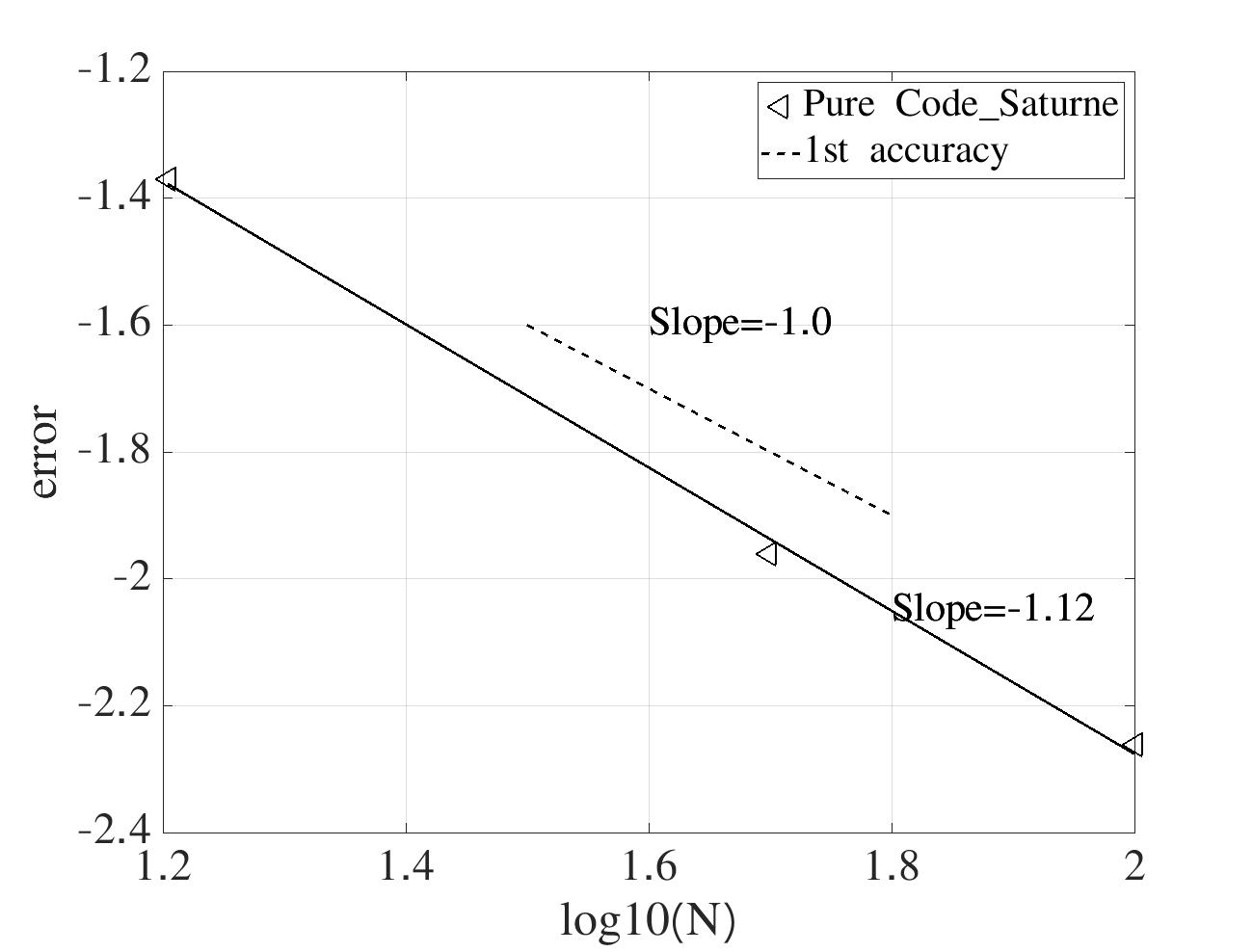
I did a convergence study using Code_Saturne v7.0.2. I tested a pseudo-3D Poiseuille flow with inlet boundary (u=4.0*(y-y*y)) and outlet boundary. Also, the domain is (1m * 1m) and uniform mesh with 16, 50, 100 resolutions. In order to ensure accuracy, I set SOLU velocity scheme. However, my results shows about 1st accuracy. Do you think this is reasonable for this case? Here I attached convergence results and setup file.
[img][PureCSaccuracy.jpg]
(1) Did you test using the default centered scheme?
I think Code_Saturne default is velocity upwind scheme, and it results is first-order accuracy. Let me test centered scheme then.
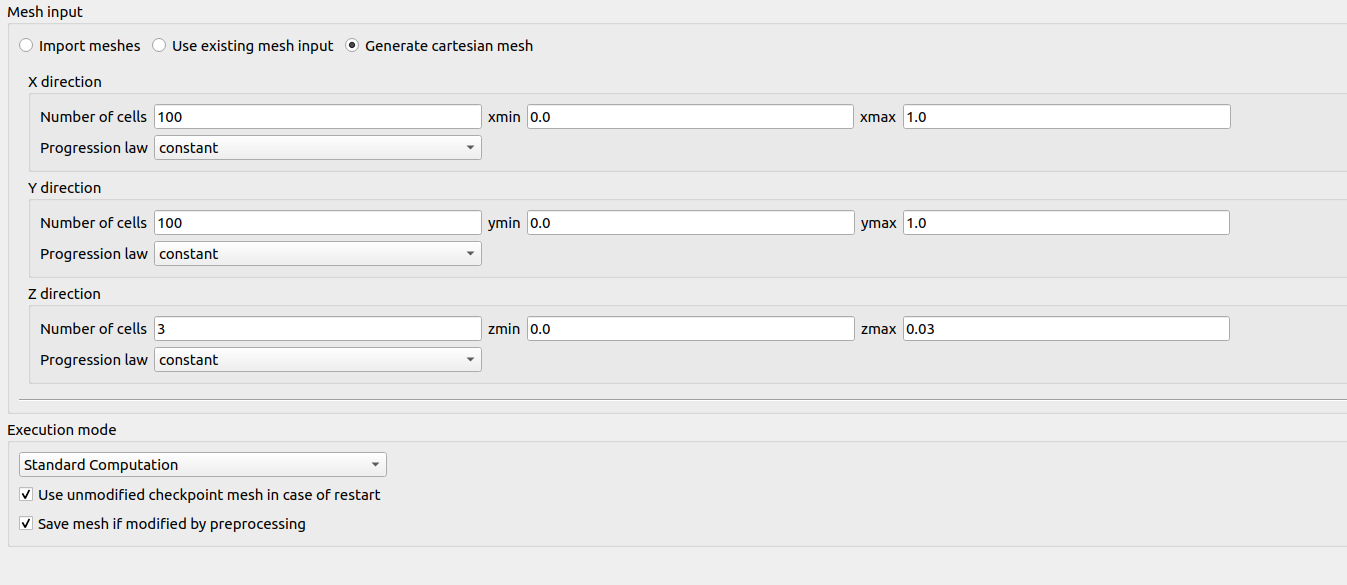
(2)what type of mesh are you using ?
I generate mesh using Code_Saturne GUI, as shown below.
Thanks for your advice in post-processing. I know the reasons and list here in case someone has similar questions:
(1) I should extract velocity component instead of resultant velocity.
(2)I extract data from the cell centre and avoid any interpolation scheme.
(3)I use velocity centered scheme in Code_Saturne.
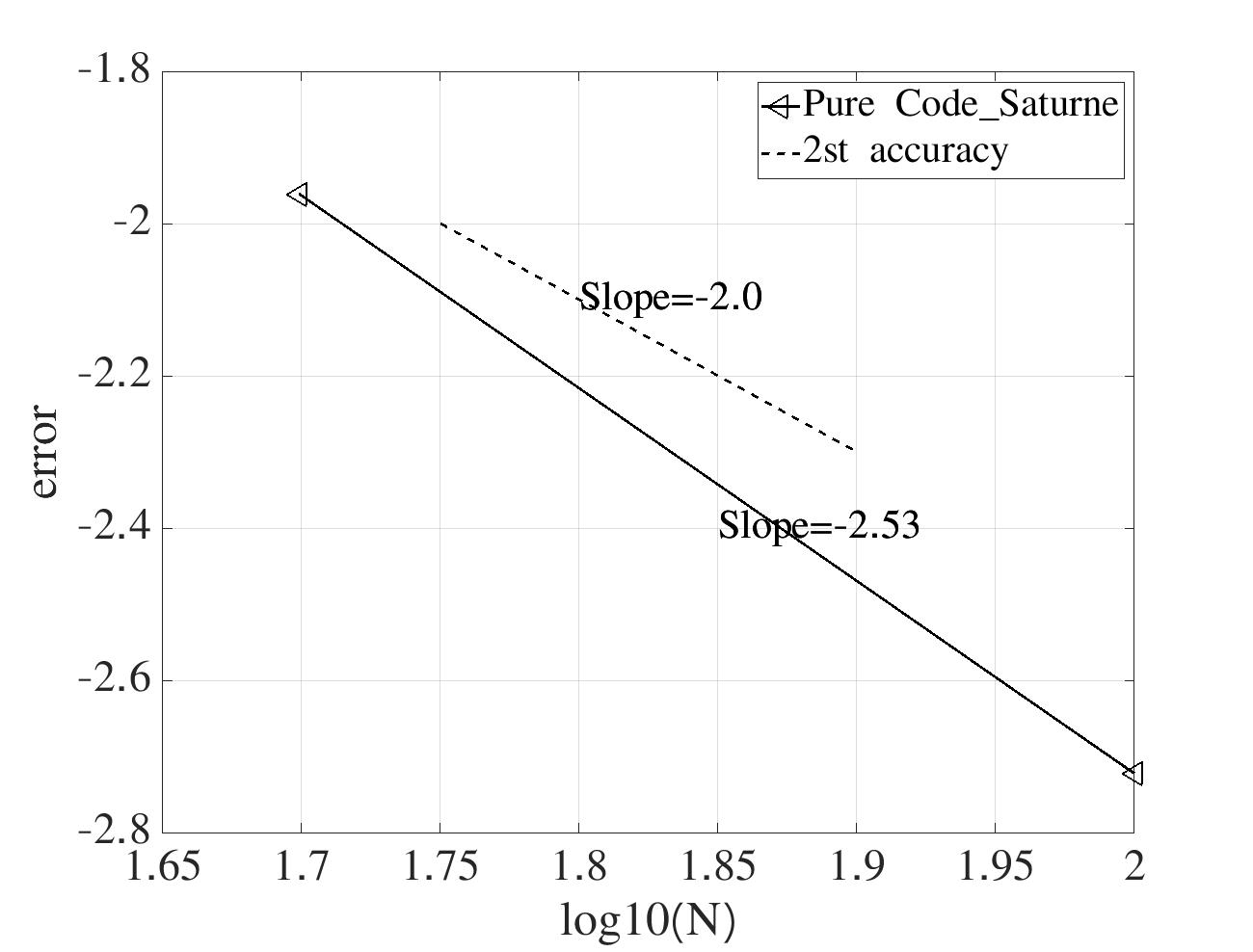
Below shows the good results:
Now that your postprocessing does not interfere with the convergence order measurement any more, I gues you should also get something close to 2nd order with SOLU, though I do not expect it to be more precise than the centered option (though it may be more robust on distorted meshes, which can be useful in industrial studies).
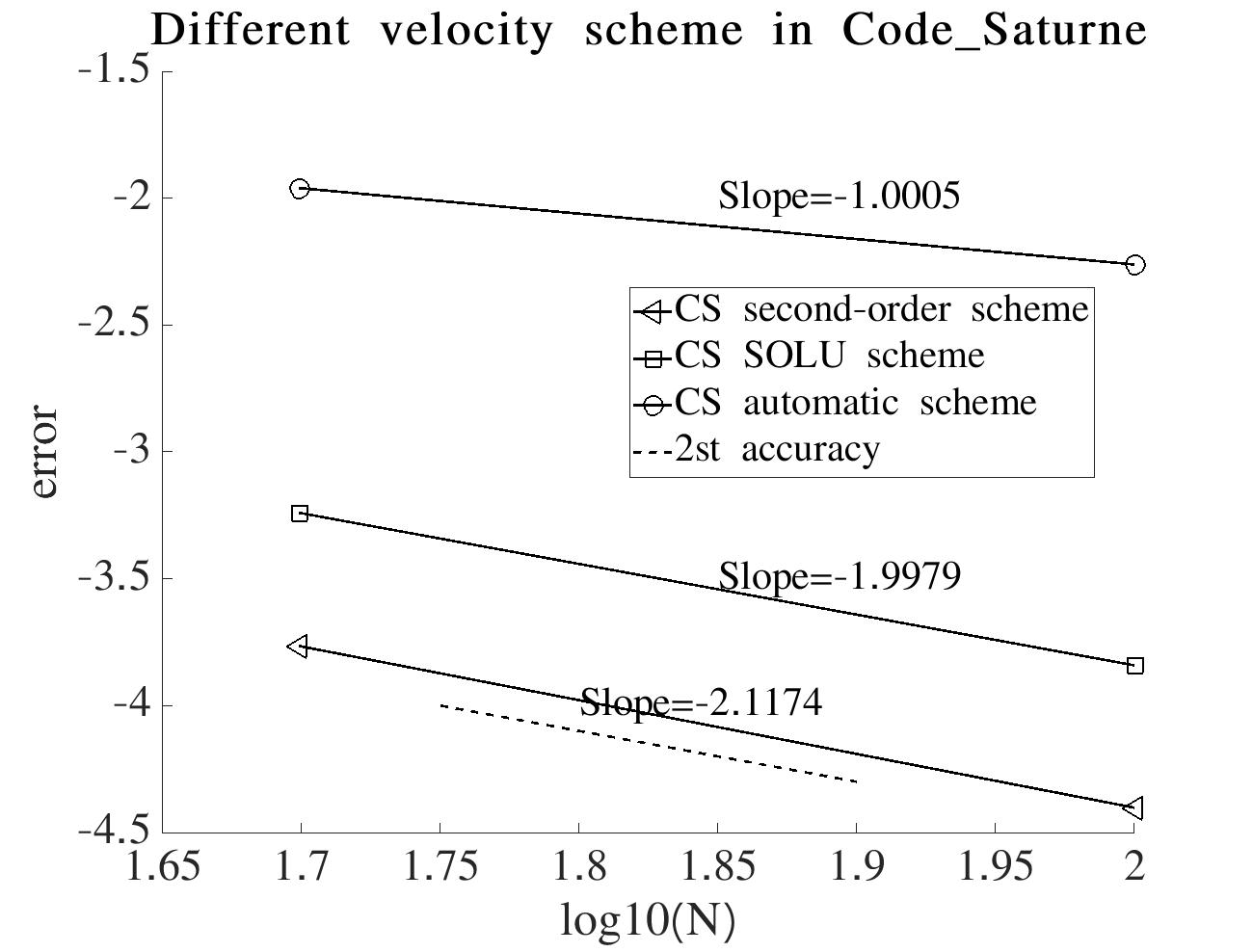
I have tested Code_Saturne three velocity scheme – automatic, SOLU and second-order scheme.
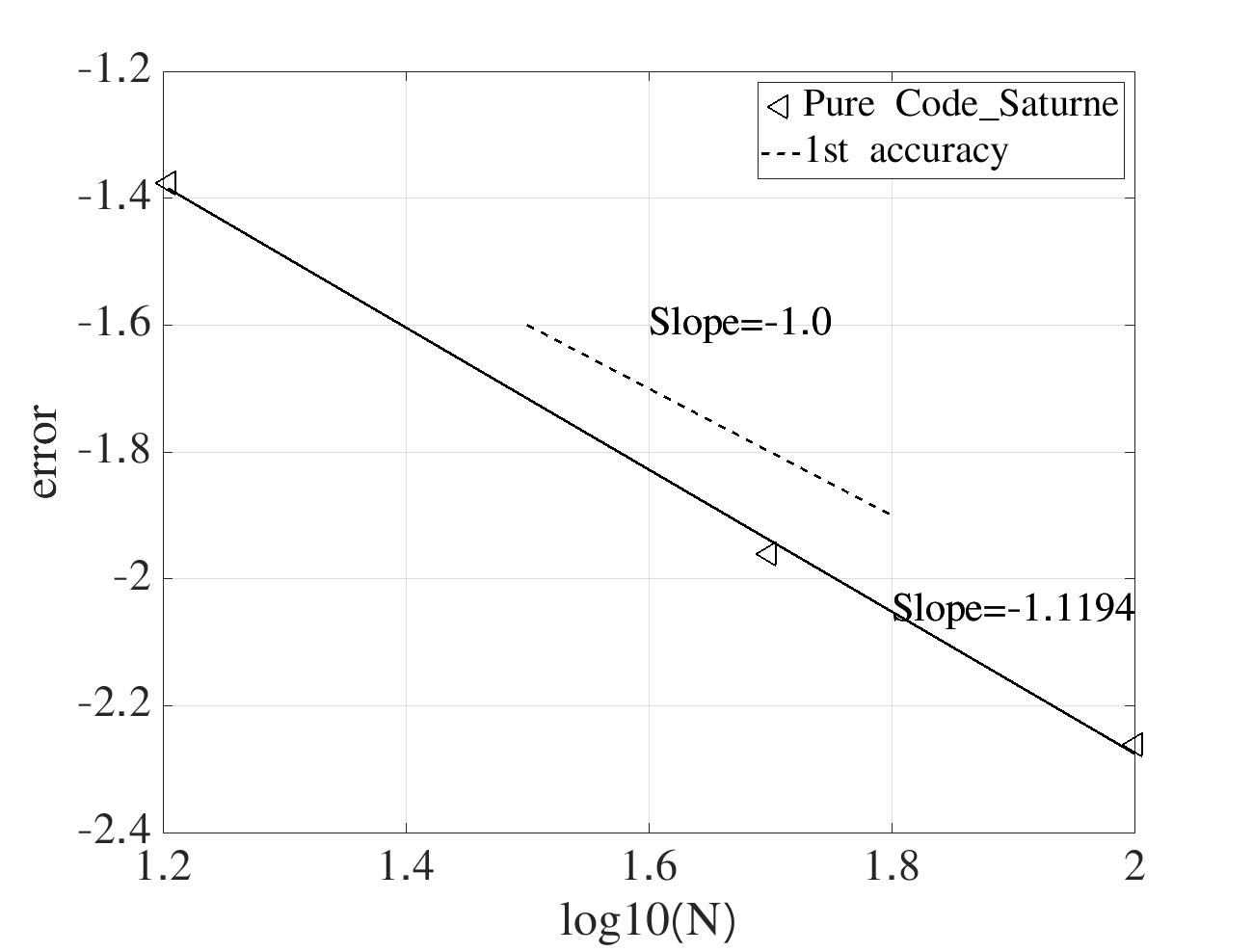
As you predicted, SOLU and second-order scheme show excellent 2nd-order accuracy, but second-order scheme has lower error. The default setup (automatic) only has first-order accuracy, as shown in below figure.
There is an upwind scheme I didn’t test (1st-order accuracy?). If I set automatic, Code_Saturne will adopt which scheme?
Correction: In previous conversation, I showed SOLU scheme has slope -2.53. This result is error because wrong boundary treatment in post-processing.
The default is centered. Or more precisely, centered with slope test. When the slope test kicks in for a given face, it locally switches to pure upwind (for that face and operation), so the convergence order drops to 1. (There is an advanced setting allowing to use blending here, but it is still work in progress).