Hello,
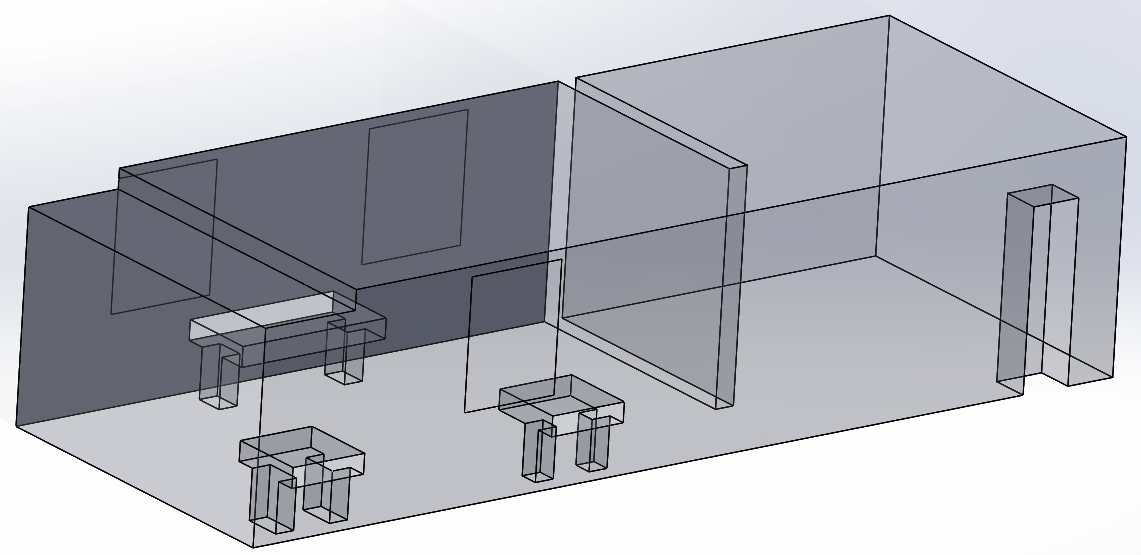
Now I am trying 3D flow simulation by URANS for simple geometric room.
The room dimensions are about 3m10m3m (width, width, hight).
More than 2miliom mesh of tetra is used for this room, and 1cm mesh is piut around outlet condition.
However, I always faced a divergence problem.
The divergence always starts from outlet boundary.
For inlet bounday condition, I put 0.1m/s velocity, and simple outlet condion is used for outlet boundary.
When I check “listing” file, I always had messages like “Incoming flow detained for 51 outlet faces on 8350”.
I am wondering what kind of setting casues this problem even though I suppose that simple settings applied to this simulaiton.
Would someone give me tips?
I think this simulation should be done easily because it is simple case.
Best regards.
Tsubasa
Hello,
Did you extrude the mesh on at least 1 layer at the outlet so as to have prisms (orthogonal to the outlet) and not tetrahedra there ? This can really help. Also, using an imposed pressure outlet is more robust than a default “free outlet”.
There are a few additional recommendations : https://github.com/code-saturne/code_saturne/wiki/Recommended-parameters-for-robustness
Regards,
Yvan
Hello,
Actually, I have to generate only tetra mesh in all region
because I will carry out a postprocessing specialized to tetra mehs result.
That’s why I am using tetra mesh only, even at 1 layer at the outlet.
In future, I want impose pressure values at inlet and outlet (pressure driven flow),
but as far as I understand, computations are often unstable when we use tetra.
I tried the recommendation you gave me, but it cannot solve the problem…
so I have to find some solution for this.
Best regards,
Hamada
Hello,
You can still use a hybrid mesh and output only the tetrahedral part (using a selection filter) for postprocessing.
Did you try the other recommended robustness parameters in the wiki ?
Regards,
Yvan
Hello Yvan,
OK, that’s is one of the options.
I tried other recommendated setting, but it did not solve the problem.
Best regards.
Hamada
Hello,
How big is your mesh ? If you have a small enough mesh and the computation crashes on it, I am interested if you can provide it so we can use it to test/improve robustness.
Best regards,
Yvan
Hello,
Mesh size is very small. Near the outlet boundary, 2cm tetra mesh is used, and other area has 5cm mesh.
Can you download a mesh file and setup file in here?
Although this geometry is not same the picture in first post, this geometry and mesh has a same divergence problem.
DIvergence always comes from outlte boundary condition.
The simulation works very well if I use hexa mesh, but I prefer tetra mesh.
Best regards,
Tsubasa
setup.xml (8.6 KB)
Hello,
Yes, I was able to download the mesh. I’ll try to run tests with it soon. Thanks.
Best regards,
Yvan
Hello Yvan,
Thank you for your help.
I am appreciate if you could let me know your result of testing.
Best regards,
Tsubasa
Hello,
How was your test?
I would appreciate if you let me know.
Best regards,
Tsubasa
Hello,
Sorry, I did not have the time to test the case yet. I’ll let you know as soon as I run it.
Best regards,
Yvan
Hello,
Ok, Thanks.
Even in steady simulation, divergence problem happned.
Best regards,
Hamada
Hello,
Changing the outlet to “imposed pressure outlet” alone was not sufficient, but switching to least-squares gradient reconstruction with full extended neighborhood, I can run 500 iterations just fine (tested with v7.0).
Best regards,
Yvan
Hello,
Thank you for the test.
I am grad to hear that steady simulation can be done by steady simulation.
Also how about unsteady case?
Do you think it can be done with Ver.6?
Finally I want to do pressure-driven flow by SRC code, but now the simulation has a divergenec problem with Ver.6.
Best regards,
Tsubasa
Hello,
I actually ran the test for an unsteady flow (as your setup.xml was set for unsteady, constant time step).
This should probably also work in v6.0, though I recommend upgrading to v7.0.
Pressure driven flow should work, but may be a bit more sensitive. Increasing the pressure difference progressively (using a ramp type function) rather than all at once might help.
Best regards,
Yvan
Hello,
Thanks a lot.
At first, I will build Ver.7 and do the test with it.
Best regards,
Tsubasa
Hello Yvan,
In the previou post, you said “least-squares gradient reconstruction with full extended neighborhood”.
Is this same to “least squares method over extended cell neighborhood” in Ver.6?
Best regards,
Tsubasa
Hello Yvan,
As you said, a simulation can be done by “least squares method over extended cell neighborhood” in Ver.6,
but the pressure difference flow simulation had a divergence problem.
In my case, pressure difference is just 0.6Pa. This is very small, but the result became divergent.
Best regards,
Tsubasa
Hello Yvan,
Do you think Ver.7 is more stable for computation than Ver.6?
(Idealy, I want to conduct a pressure driven flow by steady simulation (not URANS).)
If you think so, I want to try it with Ver.7.
If it is possible, every problem can be solved, which is posted in another post.
Best regards,
Tsubasa