Hello everyone,
I have simulated the convection coupled to radiation in a symmetry geometry.
At the end of simulation time, the time evolution of variables remains unchanged.
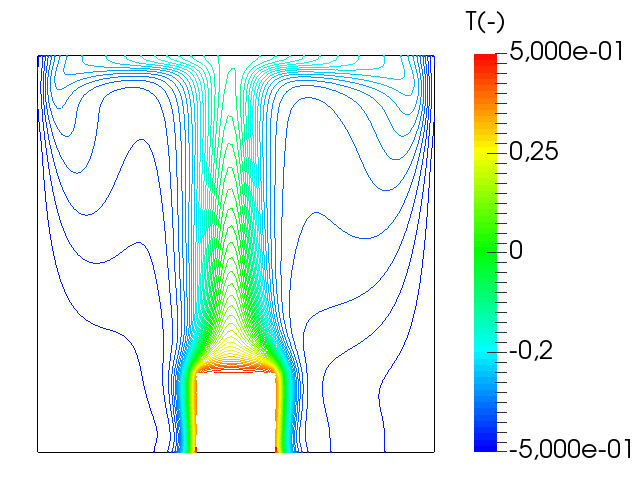
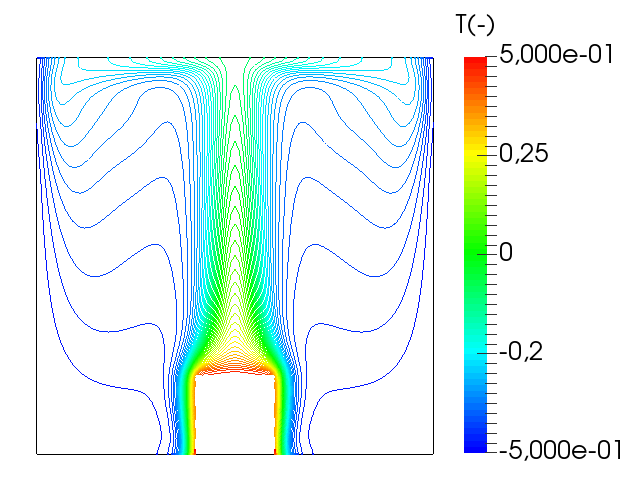
But when i visualized the results, i havenot found the symmetry field as expected.
Does it means that my solution divergences ?
If yes, can you suggest some reasons ?
Thank you,
Hello,
When a simulation diverges, it usually crashes, so if quantities are not evolving anymore, it has probably converged to a wrong solution. With the information provided, I cannot guess more.
Regards,
Yvan
Hello ,
In more details, my simulations were the coupling of double diffusive convection and gas radiation at different optical thicknesses. And in all considered cases, only one value of the optical thickness gives this strange behavior.
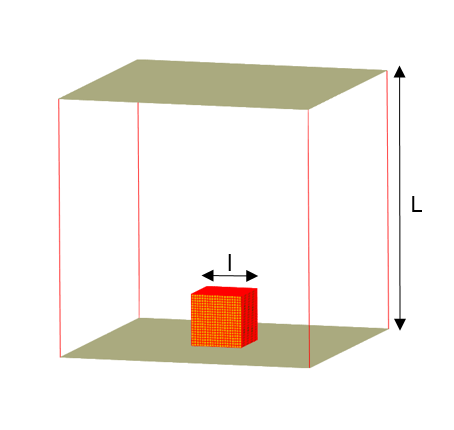
My configuration is a cubic cavity with a small obstacle (heat and pollutant source) on its floor. The top and bottom of the enclosure are adiabatic and impermeable while the vertical walls are set at a smaller temperature than that of the obstacle.
The Ra is about 5E6, Pr = 0.71, Le = 1.2.
What is the information that you need to give a guess for my situation ?
Regards,
Hello,
The forum usage recommendations list the info which can be useful.
Regards,
Yvan
Hello,
I used the Code Saturne v5.0.8.
I attach here the files from my simulation.
Please read them and give me a guess about my situation.
However, i cannot upload the listing file.
Regards,
compile.log (25 KB)
performance.log (48.7 KB)
preprocessor.log (6.88 KB)
Hello,
You are still missing the main logs (listing and setup.log), so I am still missing most of the information.
The radiative solvers converge very fast (2 iterations, while in many moderately complex cases 15 or more is more typical), so I assume this may be due to an important optical thickness, but I am not sure.
Could you try also using the GUI rather than user subroutines (art least for testing) to see if you have the same sensitivity or if it might be a bug on that side (at least, test progressively as a form of bisection) ?
With only a small part of the recommended info that is all I can say.
Regards,
Yvan
Thank you very much for your reply,
I attach here the setup.log file and zipped listing file.
Actually, i used the GUI to enter the value of absorption coefficient. But i will try your suggest.
Regards,
listing.zip (1 MB)
setup.log (29.6 KB)
Hello,
I did not notice anything strange in the logs, so this definitely seems to be in the “unexpected results” category rather than a divergence type problem.
How far from expected results are you ? Do you have any views ? Did you try without user-defined subroutines in case you have an error there ?
Regards,
Yvan
Hello,
Here are the results without (symmetry) and with radiation.
Without radiation, the thermal field is symmety but consideration of gas radiation breaks it.
For accounting radiation, compared to the without case, i only modified the absorption coefficient in the GUI.
It seem this absorption coefficient is sensitive because when i enters another one (for a higher optical thickness), i got the symmetry solotions as expected.
The user subsoutines are only for the declaration of new variables and post processing.
Regards,
Hello,
Did you compare that to the flow (for example, if you have a convective loop, it might break symmetry) ?
Regards,
Yvan
Hello,
I’m sorry but i don’t really understand ‘compare that to the flow’.
Regards,
Hello,
What I mean is that if the flow field becomes non-symmetric, it may be natural that the temperature field also becomes non-symmetric. This can happen even with symmetric boundary conditions, when the velocity becomes high enough, and a very slight perturbation (such as numerical round-off error or a non-symmetric mesh in a simulation, or a minor vibration in the physical world).
Best regards,
Yvan
Hello,
Thank you for your answer.
I compared the the flow field and it is non-symmetric as temperature.
I understand your suggestions about the reason of this behaviour.
But do you have any idea about the manner to find out the main origin (physical or numerical) ?
Best regards,
Hello,
I do not know which boundary conditions you used, so whether a higher absorbtion should lead to more or less heat difference between boundaries and more or less natural convection. If convection is stronger, symmetry can be broken more easily.
Is your mesh fully symmetric (by construction) or only symmetric at boundaries (for example generated using an automated triangle or tetrahedral mesher) ?
Regards,
Yvan
Hello
The mesh is fully symmetric and uniform.
The configuration is attached below. The obstacle is prescribed at a high temperature and concentration while the lateral walls of the cavity are at the lower values. The ceiling and bottom of the enclosure are adiabatic and impermeable. The absorption coefficient is constant for the whole medium.
Best regards,