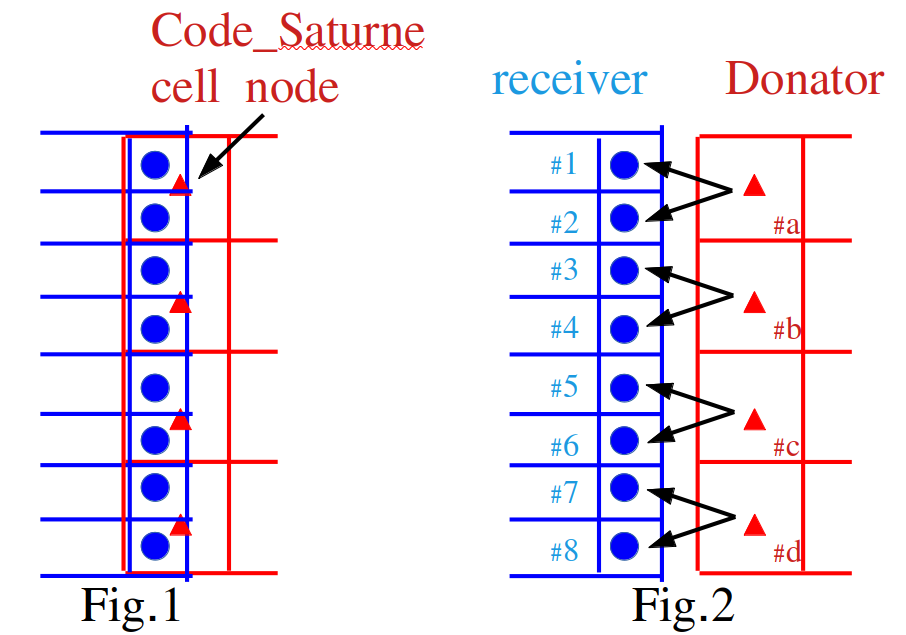
Now, I am using Code_Saturne v7.0.2 and corresponding PLE library. I have successfully achieved a coupling simulation based on different uniform mesh as shown in Fig.1. To make clear, I separate the receiver layer (blue) and donator(red) as shown in Fig.2 in which black arrow means mapping relation through function ple_locator_set_mesh.
After transferred information through function ple_locator_exchange_point_var, I found the received values at #1 and #2 are same based on simulation.( besides, #3 and #4 same, #5 and #6 same, #7 and #8 same). In my opinion, the value of #1 and #2 should be different, and obtained by interpolation method from #a. Could you help me explain this?
Thanks!
This is related to PLE being used for a code_saturne, where interpolation is based on reconstruction (with different gradient options), and not on shape functions.
The simplest (and most commonly used) interpolation used in this context is tu do a P1-reconstruction using a 1st order Taylor expansion (and which involves computing a gradient).
I have fixed this problem through the 1st order Taylor expansion.
By the way, I’d like to make clear using of the function ple_locator_set_mesh. For this case, I want to achieve one-way information transformation from donator to receiver. On the receiver side, I defined the coordinates of coupling points (i.g. #1, #2, #3, #4, #5, #6, #7 and #8), while on the donator, I also defined the coordinates of coupling points(#a, #b, #c and #d). Then, I placed the coordinates array to 10th term of function ple_locator_set_mesh and both donator and receiver software call function ple_locator_set_mesh to establish mapping relationship. Finally, dornator extracts data by function ple_locator_get_n_dist_points and ple_locator_get_dist_locations and sends to receiver.
Is it necessary to define the coordinates on donator side (like: #a, #b, #c and d)?
No, for one-way coupling, you only need to define points on the receiver side, and only need to define the mesh on the donor side (and use NULL for points on the donor, and optionally also NULL for the mesh on the receiver side).