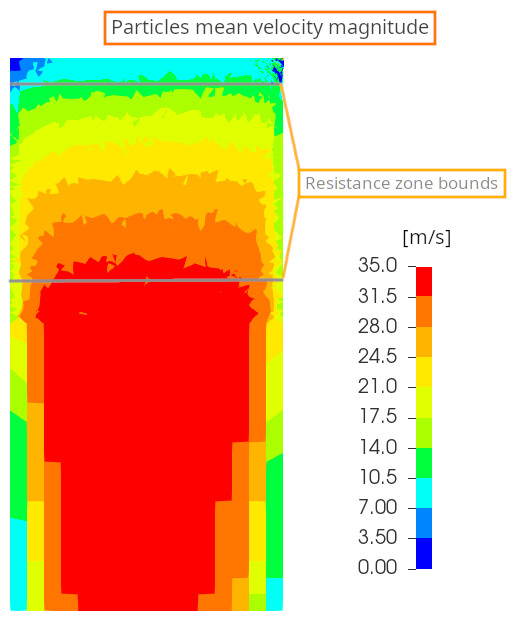
Hello. I guess I found the bug in Saturne 6.0.6. I’m not allowed to share the entire geometry, but, I think, it’s not a matter of particular case. In this case, there is a gas duct with recirculation line intake and head loss volume zone that represent the tube bundle. Gas phase calculation was successful (tube bundle resistance is accounted for without problems), then I introduced particles on frozen gas velocity field. Although particles move by expected streamlines, when they enter volume zone with head losses, their velocity rises gradually by ~25m/s (gas velocity is around 7.5 m/s in this area). I attached picture with particles mean velocity field.
Case setup is very basic. Gas velocity in problematic area is ~7.5 m/s (aw well as particles velocity before resistance zone), gas pressure drop across resistance zone is ~250 Pa at height of 1.2 m (resistance coefficient is 16.8 m^-1). Gas density is 0.365 kg/m3, dynamic viscosity is 3.17e-05 Pa*s. There are 9 particle fractions (classes) with sizes from 2.5 to 100 mkm. I attach case setup [xml] files for gas-phase and particle runs (case for gas-phase run is marked with A suffix that means “pure aerodynamic”). Please note that, in particles case, some values for gas phase are not set.
I tried Saturne 6.3 feature version but I was unable to set resistance coefficient in this version. GUI just doesn’t accept it, when you switch to another dialog and back, all 3 resistance coefficients become zeroes whatever you set.
Would anybody, please, fix this particle acceleration in resistance zone? Maybe pressure gradient force is accounted for incorrectly?
BTW, Saturne gave 11% of particles coming into recirculation line while Fluent gave 15% that is quite good agreement (this case’s purpose is to ensure that Fluent doesn’t give us too low particle fraction in recirculation line).
D-G000-R000-S000A.xml (16.8 KB)
D-G000-R000-S000.xml (17.6 KB)